Menu
Introduction
IDEAS, an acronym for "Industrial Distribution Education Association Sales" was founded in South Bend Indiana by three former employees of Dodge Manufacturing; John Gyorgi, Bob Grundtner and Lee VanStone.
The objective of the company was to provide generic training relevant to the identification, selection and maintenance of Fluid and Mechanical Power Transmission components to A) Industrial Distributor Personnel and B) Industrial End Users.
The first class was conducted in the fall of 1972 on the campus of Notre Dame. The actual length of the first PT Workshop was six weeks. Students attended class for two weeks of training, returning to their jobs for two weeks and returned for another two weeks, repeating this sequence until all 6 weeks of the curriculum had been completed.
In April of 1993
Ron Whistler purchased IDEAS from then owner Bill Pitcher.
In January of 2015
Ron Whistler suspended NEW IDEAS, INC.'s training initiatives and his two sons; Parrish and Chadd joined the company as principals and Senior Vice Presidents.
The primary MISSION was and is to explore new opportunities within new markets and to continue to implement new ideas using
INNOVATIVE EDUCATIONAL TECHNIQUES AND NEW
TECHNOLOGIES TO MAXIMIZE A LEARNING EXPERIENCE
A CHRONOLOGICAL LIST OF EVENTS LEADING TO THE January 2015 CHANGE IN NEW IDEAS, INC. IS AS FOLLOWS
In June of 1998
Ron Whistler suspended regularly scheduled training programs offered by NEW IDEAS, INC. (formerly IDEAS) to pursue Long Term Contractual Training and Development opportunities.
From June 1998 until January 2015, NEW IDEAS, INC./Ron Whistler provided customized training, development and implementation, of training programs, on a contractual basis, for Industrial Manufacturers, Training companies and major trade Associations.
In April of 1993
Bill Pitcher, because of personal reasons decided to discontinue his association with NEW IDEAS, INC.
Ron Whistler purchased the company from Bill Pitcher (including all rights to the IDEAS curriculums) except for the "PST" (Professional Selling Skills) program.
Bob Baker retained the IDEAS PST curriculum
Ron Whistler added Soft Skill and Predictive Maintenance training curriculums to the IDEAS product line.
June of 1992
THIS BEGAN A TRANSITION PERIOD FROM IDEAS TO NEW IDEAS, INC.
Bill Pitcher REORGANIZES IDEAS After Bob Baker announced his intentions to retire from IDEAS.
Bill Pitcher asked Ron Whistler to take over the general management of IDEAS.
A new company was formed under the name of NEW IDEAS, INC.
All rights to IDEAS and its products were transferred to NEW IDEAS, INC. and the operations were moved from South Bend, Indiana to Kansas City, Missouri.
January 1990 - IDEAS
Bill Pitcher contracted Ron Whistler as a part time instructor for IDEAS.
September 1989
Ron Whistler left IBT as their Corporate Training Director and formed his own training company WHISTLER & ASSOCIATES offering Bearing Maintenance and Lubrication Maintenance training seminars to industrial manufacturers and educational facilities.
1988 - IDEAS
Bill Pitcher is appointed Director of Training for Motion Industries. Due to his schedule with Motion, he is forced to resign his position as President with IDEAS.
Bill Pitcher maintains his involvement with IDEAS as owner and silent financial partner until 1993.
1986 - IDEAS
Bill Pitcher buys the rights to the IDEAS curriculums from Bob Grundtner's estate.
Bill Pitcher becomes the owner and President of IDEAS.
1986 - IDEAS
Bob Grundtner served as the President of IDEAS until his untimely death in January of 1986 at the age of 56.
Many of the initial concepts and curriculums that influenced the organizations
goals and objectives of IDEAS are due to Bob Grundtner's insights.
1980 - IDEAS
Bob Grundtner hires Bill Pritcher as a part time instructor specifically for the Hydraulics curriculum offered by IDEAS.
Bill Pitcher at the time was the director of the Hydraulics training program for Motion Industries.
1977 - IDEAS
Bob Grundtner hires Bob Baker in the fall of 1977 as General Administrator and Principle Instructor.
Bob Baker maintained this position with IDEAS until announcing his retirement in June of 1992.
1975 - IDEAS
John Gyorgi left IDEAS to accept an offer from the Masten Bearing Division of Eagle-Pitcher Industries as Vice President of Sales and Marketing.
John Gyorgi held a number of challenging positions including; Chairman and CEO of Bunting Bearing Corporation in Holland Ohio.
1973 - IDEAS
Lee VanStone left IDEAS to accept an offer from Motion Industries, Inc. to manage their Fluid Power Division in Birmingham, Alabama.
Lee VanStone stayed with Motion until 1987.
He resigned his position with Motion and moved to Coldwater, Michigan.

Innovation
Only 11% of the Fortune 500 companies from 1955 still exist today and the average time that companies stay in the top 500 has fallen from 75 years to 15 years.
The race for national competitiveness includes competing for: investments, talent, growth, and opportunity. Those that are pushed out of the running surrender the greatest prize of all: prosperity.
To achieve prosperity companies must focus on what really matters: How to be like the 11% of companies that have remained through the decades in the top 500. The secret of these successful companies is constant INNOVATION
"Sometimes when you innovate, you make mistakes. It is best to admit them quickly and get on with improving your other innovations."
The key to INNOVATION is not; an intellectual luxury, a topic confined to seminars and panel discussions, or a matter only of administrative reforms;
It is the recipe for human survival and the development, the fuel for consistent progress, and the blueprint for a company's survival.
The first key to business success is: INNOVATION that is used to focus on its employee's skills.
Top-tier companies continuously invest in their employees to provide them with the right skills that nurture INNOVATION - across key sectors of the company's business and marketplace. This requires constant EMPLOYEE EDUCATION.
A United States Department of Labor study found that:
65% of children currently in primary school will grow up to work in jobs that do not exist today
Another study at Oxford University found that:
47% of job categories are at high risk of ceasing to exist because they can be automated through technology.
These two studies set the stage for how a company should plan for its future and how it should compete, not only today, but in the coming future.
A company's success will depend on its INNOVATIVE-EDUCATIONALCREATIVITY to provide the employees with the analytical and communication skills needed to be competitive now and in the future.
The second key to business success is: INNOVATION that: A) uses the skills of its employee's, B) focus' on their creativity, analytical and communication skills and C) shifting investment towards the intangibles. . .
EXAMPLE:
More than 80% of the value of the Standard & Poor's 500 consisted of tangible assets, 40 years ago.
Today that ratio is reversed: more than 80% of the largest companies' value is intangible; the knowledge and skills of their employees.
NEW IDEAS INC.’s background and the experience Chadd and Parrish Whistler ads to its depth in INNOVATIVE training, going forward, ideally positions it continue to provide innovative educational services that will inable companies to compete now and in the coming future.
Training
Training, when properly positioned, serves as a backbone to corporate strategy. And, training can contribute to this country's ability to gain back its position as a world competitor.
The importance of industry taking a leadership role in providing the workforce with the appropriate training to effectively meet these changes was emphasized in a report published by the National Council on Vocational Education titled "Time for Action". Per this report:
"Unless the powers of this country...does something to encourage training of competent, qualified workers for the jobs that need doing, our position in the world market place will be seriously, and for the long term, jeopardized."
Beginning with the 21st century we have seen and are continuing to see an accelerated amount of change in all levels of the workforce as companies strive to become world class.
The impact this is having on industry and training was addressed in a document published by the American Library Association. Per this report:
"New learning models need to be implemented that are based on using information resources from the real world and on learning methodology that is active and integrated, not passive."
Today's and tomorrow's training programs have to create a culture within a company that coincides with change. Part of the challenge is designing a training program that is keeping pace with new technology, the needs of the company, the needs of the market place and new training techniques.
Industry can, through training, emphasize what needs to be done with the existing proliferation of information so that operating costs are reduced, equipment uptime is increased, productivity is increased and bottom line profits are increased.
CLICK ON ANY ONE OF THE SERVICES BELOW TO GET FURTHER INFORMATION ON HOW NEW IDEAS INC. PROVIDES THE HIGHEST RETURN ON TRAINING DOLLARS SPENT, OPTIMIZED PRODUCTIVITY AND HIGH RETENTION.
Needs Analysis
The following comments were taken from an article titled "Development Starts With Assessment" by Stephen E. Forrer that appeared in the Journal Executive Excellence, Vol. 7, May 1990 and as prophesied is to this day very appropriate:
In the coming decade, career development will become employee development. In a model for implementing career development programs, the role of assessment becomes clear: critical jobs and skills must be assessed.
Recruitment, employee retention and training will be the key to managing human resources in the 21st century.
To be successful, companies must undertake accurate and relevant assessments. Employers must recognize the need to provide flexibility and be willing to adapt to change.
Over the years, Training Needs Analysis (TNA) has been done in a variety of ways using a multitude of different forms. Initially, needs analysis was derived from a questionnaire that simply asked the participant to check off training courses they felt they needed in order to perform their job. Requirements were informally gathered and lightly documented. Justification frequently came from what was thought was needed, not from what was really required.
Focus Input Meetings are used to establish the structure of a training event and/or series and should include: A.) selected management personnel B.) Selected sales personnel and C.) A selected customer base and D.) conducted as one-on-one meetings with each of the above designated employees
Based on the information obtained during one-on-one focus meetings, a list of topics should be incorporated into survey forms and distributed to a much broader base of potential training participants.
The result of this follow-up survey should:
New Ideas, Inc. uses a 5-step analysis of the results of the survey(s) referred to above.
Step 1:
Determine:
Step 2:
The results of Step 1 will be cross plotted to determine training priorities. For example:
Step 3:
After cross plotting the above sets, a combined cross plot is made to compare training priorities between:
Step 4:
The results of Steps 1 - 3 are used to prioritize training needs and develop a training curriculum(s) with respect to, but not limited to:
Step 5:
Training curriculum(s) should be implemented taking into consideration available training resources versus the company's specific needs. This will require assessment of the following in order to achieve maximum productivity in the shortest amount of time versus the dollars required to provide training.
BMI
As a senior consultant to the From Institute Ron Whistler & NEW IDEAS, INC. has played a key role in developing and administering several Business Management Institutes (BMI’S) for prominent trade associations; Example: A.) the Automotive Wholesale Distributor Assn. (AWDA), B.) Jewelers of America, C.) Automotive Service Assn. (ASA), and D.) Automotive Engine Rebuilders Assn. (AERA).
Each BMI consisted of a series of technical courses specific to the nature of the association and five major tracks on Soft Skills, including:
The BMI was generally designed as a 4 year educational/training program.
The primary objective: Grow membership, retain membership
The secondary objective:Increase revenue, increase membership participation and attendance at regional conferences and/or the annual convention.
Note: to obtain optimum employee acceptance of a training program it is best to use members from within the association or company who are SME's (Subject Matter Experts) to help develop, select topics and/or write core curriculums.
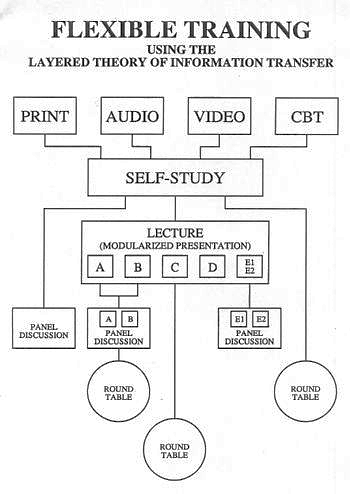
Curriculums are best structured on the principle of the "Layered Theory of Information Transfer".
For a maximum return on training dollars, if more than one form of a presentation on a given subject matter can be provided, this will increase the student's ability to learn and retain information. If a classroom environment is possible and training time available, the format of the Layered Theory of Information Transfer is recommended.
This format provides a flexible and optimum learning environment. It takes into consideration peer input and the way a person likes to learn.
This format is especially suited for trade associations during regional and/or annual conferences.
SEP
The Strategic Educational Plan, when completed, should serve as a foundation for A) guiding the company's future training activities, B) anticipate and serve its customers needs as well as its employee growth objectives and C) contribute to "Total Quality Improvement Initiatives".
Strategic Educational Planning as a means of improving the effectiveness of the company's efforts to establish quality service is a relatively new concept. At the beginning of the 1960's, after the publication on "Long-Range Planning for Management" by David W. Ewing, a great deal of attention was directed toward the nature, theory and process of planning.
In more recent years, the tools and techniques of business planning have been used to develop Strategic Educational Plans in order to deal with the complexity of competing in today's global markets. Some of the issues addressed in this approach include:
Strategic Educational Plans, when properly implemented within a company, will allow management to deal effectively with the need to direct the company towards pre-defined educational goals which in turn supports the company's efforts to establish a quality environment.
A Strategic Educational Planning Survey is the basis for establishing a cost-effective training program. For example; when an association is considering a Business Management Institute, the objectives of the survey should be:
Issues that impact the structure of a Strategic Educational Planning Survey for a company and/or association and/or an Industrial Distributor are:
The planning process used to structure a survey involves a number of sequential activities each of which builds on the information and direction generated from the previous activity. These activities include conducting Focus Input Meetings with:
The results of these meetings will provide the basis for developing a Training Needs Analysis which will provide the basis for developing a training curriculum.
Get in Touch